
Tracing Former Owners of a Shenandoah County Property
The Library of Virginia catalog lists dated index and deed-book runs for Shenandoah County. Those entries anchor the historic side. No published cutoff marks where the live online index stops, so coverage of recent Shenandoah County deed records remains an open question. The table separates confirmed historic collections from uncertain online coverage.
| Source | Years It Covers | Where Held | What It Shows |
|---|---|---|---|
| Virginia SRA / COVERS index | Local start year not published | State portal and Circuit Court Clerk | Party and instrument references where enabled. |
| General deed indexes | 1772-1820; 1820-1852; 1852-1884; 1884-1899; 1900-1921 | Library of Virginia microfilm catalog and Clerk | Party lookup leading to a book and page. |
| Deed books and release deeds | 1824 to at least 1911; releases 1883-1919 | Library of Virginia and Clerk | Recorded instrument and transfer description. |
| Surveyor books and plats | Surveyor runs begin in 1785; other coverage varies | Library of Virginia and Circuit Court Clerk | Older boundaries, adjoining owners, lot and tract clues. |
A recent transfer starts with the Clerk's index. For older deeds, match the index run to its period, note the book and page, then pull the deed image or the microfilm that holds it. The recorded conveyance is the proof. Historic land books and probate files supplement a Shenandoah County deed chain, but they never replace the instrument that actually moved title.
Walking the Shenandoah County Deed Chain Backward
A grantor conveys an interest in land. A grantee receives it. To walk the Shenandoah County deed chain backward, confirm that each instrument describes the same tract, then treat its grantor as the prior party. Find the deed where that person received the land. Legal descriptions and adjoining-owner clues matter, because an old instrument may never mention a modern street address in Shenandoah County property records.
- Find the latest deed that matches the parcel and note the grantee, grantor, date, and reference.
- Search the grantor's name as grantee to locate that party's acquisition instrument.
- Compare legal descriptions, tract names, acreage, and adjoining owners before linking the next deed.
- When the online index stops, use the relevant general index and deed book through the Clerk or LVA catalog.
- Grantor
- The party conveying an interest in an instrument.
- Grantee
- The party receiving the stated interest.
- Chain of title
- The sequence of recorded transfers linked to the same land.
- Legal description
- The lot, tract, or measured land wording used to identify the property.
- Quitclaim / warranty
- Different deed forms; read the recorded instrument for the actual terms.
How Far Back Shenandoah County Ownership Records Go
The online index start year is not published. A web search alone cannot cover every Shenandoah deed. The Library of Virginia catalog reaches much deeper, with general deed indexes beginning in 1772, surveyor books from 1785, County Court Papers from 1787, and land grants from the 1790s. That is a research ladder. It lists the collections, not a promise that every original deed image sits online for a Shenandoah County property search.
Index limit. Shenandoah County's SRA start year is not published in the captured county material. Older deed indexes are cataloged from 1772; confirm the right run and access route with the Clerk or Library of Virginia.
Shenandoah County Indexes on Microfilm
The LVA catalog splits the general indexes into period runs. These are 1772-1820, 1820-1852, 1852-1884, 1884-1899, and 1900-1921. Use the party index first. It yields a deed-book reference. Then read the entry. Run labels matter. A party can appear in more than one book or under spellings that shift across an older handwritten Shenandoah County index.
The Clerk reports that permanent county records are continually microfilmed. They are securely stored at the State Library in Richmond. Ask the Clerk about local access before requesting a reel or book.
The Library of Virginia's Shenandoah finding aid lists the index runs. It also lists the related deed books a backward search relies on.
The Library of Virginia's Shenandoah County catalog goes further. It identifies the collections that shape a plan for historic Shenandoah County property records work.
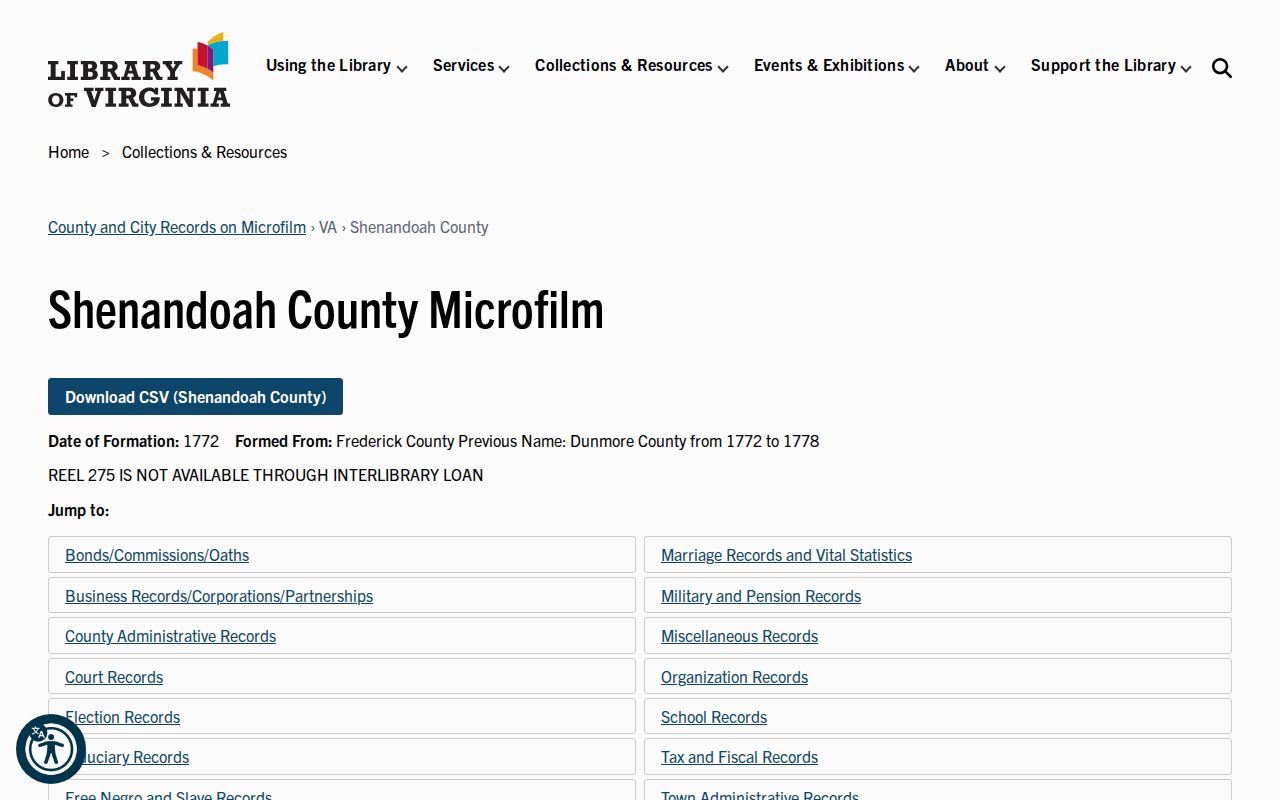
Match the entry to its deed image or reel.
Old Tracts and Present Addresses
An old Shenandoah County deed may name the land by tract, metes and bounds, acreage, or adjoining owner. It may do so instead of a street number. The parcel description bridges that gap. Copy wording exactly. Pull the phrasing from the current assessment book or the latest deed. Do that before opening an older index of Shenandoah County property records.
Current books carry subdivision names like Madison Heights, Waverly View, Orchard Place, and Green Acres. One record reads "S of New Market US 11." That is a location phrase. It is not a street address. Pair such language with GIS and adjoining-owner references. Only then decide that an old deed and a modern parcel describe the same piece of Shenandoah County land.
Probate Files and Broken Name Chains
A tidy grantor-grantee chain sometimes appears to stall at an owner's death. That pause usually means the land passed through probate. Shenandoah County's Circuit Clerk keeps wills and fiduciary qualification files permanently. The eventual transfer may surface as an executor's deed, a fiduciary deed, a court order, or a partition instrument. To tie a probate file to the recorded land instrument, search the estate name. Also search the decedent, an approximate death date, the fiduciary, and the parcel description. Name and date matching does most of the work here. A will can name heirs and describe property. But the will alone rarely shows the later conveyance. So always follow it into the deed index. VDH holds death certificates, and access to current records is restricted. Under state rules, they become public after 25 years. Keep probate files and deed records separate, then link them through names, dates, and the legal description.
Surveyor Books and Platted Lots
Surveyor books in the LVA catalog reach back to 1785. They continue into the later nineteenth and early twentieth centuries. They often preserve bearings, adjoining landowners, and tract geometry. That helps when a chain crosses a subdivision or a boundary change. The Circuit Court Clerk also holds plats. GIS offers a current parcel view, though it is not the controlling description. Working a named subdivision takes a specific order. Copy the section and lot from the tax record first. Then look for the recorded plat and any earlier deed references tied to that lot. For older rural property, compare survey calls and adjoining owners. Do not assume today's map shape has always held. Boundaries move. A licensed surveyor can interpret old calls or locate the lines on the ground. The Shenandoah County parcel-map reference explains how current GIS lines up with recorded lots.
Local Archives and Deed Abstracts
The Shenandoah County Library preserves a deep local-history collection. Its Shenandoah Room and Truban Archives hold ledgers, letters, photographs, business records, and similar materials. Research services may involve fees, so confirm holdings and terms before sending any request. FamilySearch catalogs an abstracted first volume of Shenandoah deed books. An abstract can point you to a party or a book and page. Always verify the abstract against the original instrument. Deed records summaries can omit details that matter to an ownership chain.
The county historical society offers another route into Shenandoah County history. It is housed at the Historic Courthouse. Its exact holdings in city directories, obituary indexes, cemetery database fields, and newspaper coverage vary. Ask the library or archives directly what survives and which years staff can search. Skip the guesswork there.
The county library research guide describes the Shenandoah Room and Truban Archives.
Clerk Counter and Index Fallback
The Shenandoah County Clerk of the Circuit Court is the local fallback for public land files and current index questions. The office is at 112 South Main Street in Woodstock, 540-459-6150, weekdays 9 a.m. to 5 p.m. Staff guide access to public files, and certified or uncertified copy prices were not located in the county material. Ask about the current schedule before ordering.
Virginia FOIA requests should describe the party, tract, record type, date range, and reference if known. The general response period is five working days, subject to allowed clarification and extension. For a single deed copy, follow the Shenandoah County deed-records instructions; this page's focus is the chain of former owners.
The Library of Virginia groups Shenandoah general deed indexes into 1772-1820, 1820-1852, 1852-1884, 1884-1899, and 1900-1921 runs. Search the period that covers the likely recording year, then use the index reference to identify the deed book and page. If a chain crosses one of those spans, carry the last known grantor forward into the next index rather than treating the end of a volume as an ownership break.
Start the party lookup at Virginia SRA/COVERS when a current index is available.
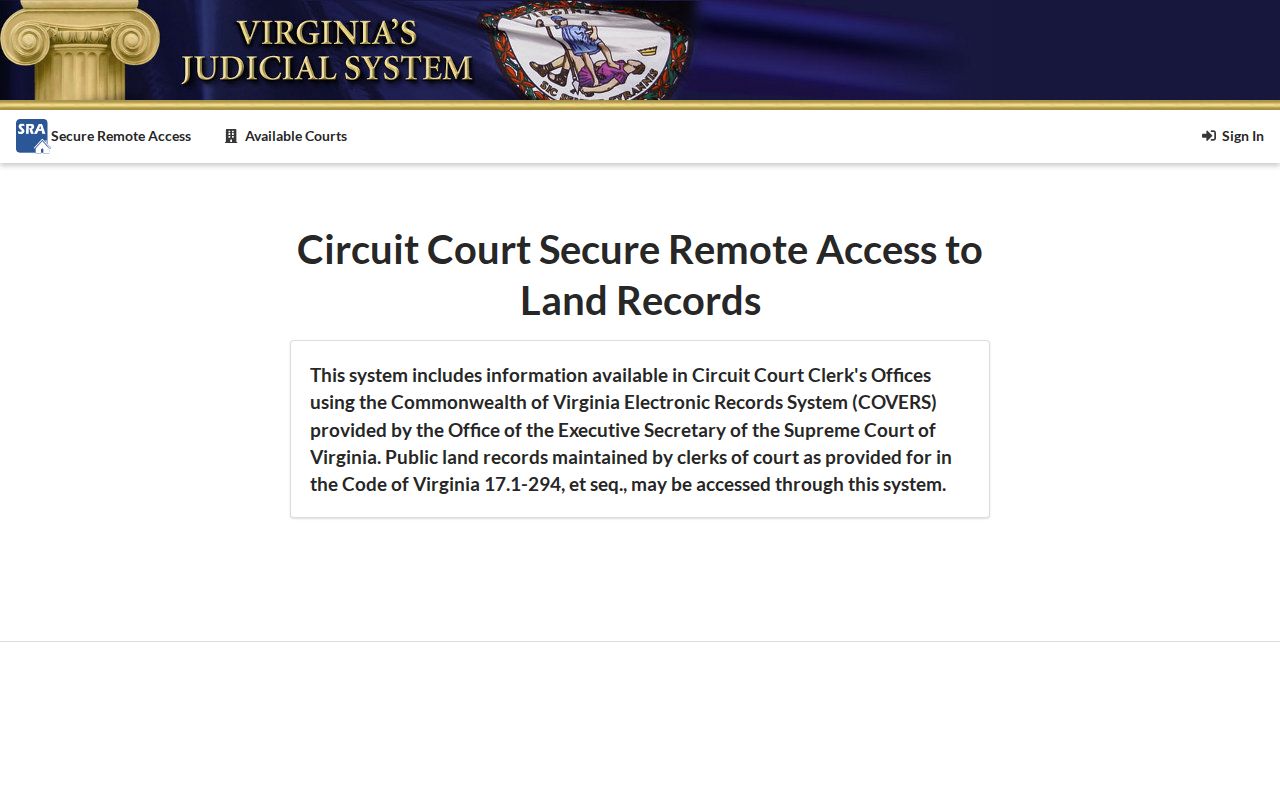
The image shows the statewide index route. Confirm any local result and image restrictions with the Circuit Court Clerk.