
Shenandoah County Property Value Types
Three numbers, three purposes. Virginia law requires real estate to be assessed at 100% of fair market value. Yet the assessor's mass-appraisal result remains a figure for the tax roll. A market value is a wider estimate. It reflects what a property might bring under stated conditions. A sale price is the consideration in a deed. The Shenandoah County assessment book lists land, improvement, total, and tax fields for each parcel. It does not carry a full history of sale prices.
| Value | What It Is | Where |
|---|---|---|
| Assessed value | County valuation used for real-estate tax; Virginia's required level is 100% of fair market value. | Commissioner of Revenue roll and real-estate book. |
| Market value | An estimate of likely value under market conditions; not confirmed as a separate live card field. | Assessment method or independent appraisal, depending on the question. |
| Sale consideration | The amount stated for a recorded transaction when available in the instrument. | Recorded deed image; local online capture is not confirmed. |
| Land / improvement | Separate assessed components that contribute to the total. | 2026 county real-estate book and assessment detail. |
An assessed value is not a promised sale amount. It belongs to a tax year and may shift with the reassessment cycle. The latest deed can still serve as a transaction reference. Just note that a sale price does not appear on every online assessor card or index result in Shenandoah County.
Looking Up a Shenandoah County Property Value
The county-linked actDataScout real-property search is the public starting point for a parcel value. Query it by address, owner name, or tax map reference. Then compare the matched description against the assessment book. The detailed card labels its own fields. A separate market-value line may or may not appear. Treat the book's land, improvement, total, and tax fields as the public roll. They are not proof of a current sale price.
- Find the parcel in the county-linked assessment search and confirm its legal description or tax map key.
- Read the current land, improvement, and total assessment fields and note the effective year.
- Use the Clerk's land-record index to locate a deed when a transaction reference is needed; do not assume the result shows consideration.
- Compare other parcels only when their location, size, use, and record date make the comparison meaningful.
- Assessed value
- The county's tax valuation for the property.
- Market value
- An estimate of likely exchange value under defined conditions.
- Assessment ratio
- A comparison of assessment amounts with sale prices in a study; it is not a parcel-specific guarantee.
- Sale consideration
- The amount associated with a recorded transfer, where the instrument or index discloses it.
- Reassessment
- A new countywide valuation cycle applied on an effective date.
Limits of a Shenandoah County Value
A Shenandoah County assessed value is a mass-appraisal figure for the tax roll. It is not a private appraisal. Buyers and lenders order their own. An assessment can also differ from a recorded deed price. The dates, property details, and market conditions differ. The county's online portal does not always show a last sale date or assessor-chosen comparables.
Value vs price. A Shenandoah County assessment does not state what a property will sell for. A licensed appraiser can provide an independent opinion for a transaction.
2022 and 2026 Assessment Dates
Shenandoah County's prior general reassessment took effect January 1, 2022. Vision Government Solutions handled the newer reassessment, effective January 1, 2026. A public value always belongs to a period. A jump between periods does not by itself mean a parcel boundary or characteristic changed, only that the roll was rebuilt for a new date. The county mailed notices in batches beginning December 10. The Board of Equalization takes evidence by appointment. Its review path addresses contested tax assessments. Evidence and filing dates belong on the property-tax-record page, not in a sale-price comparison. The county's reassessment notice explains the effective date and current review path.
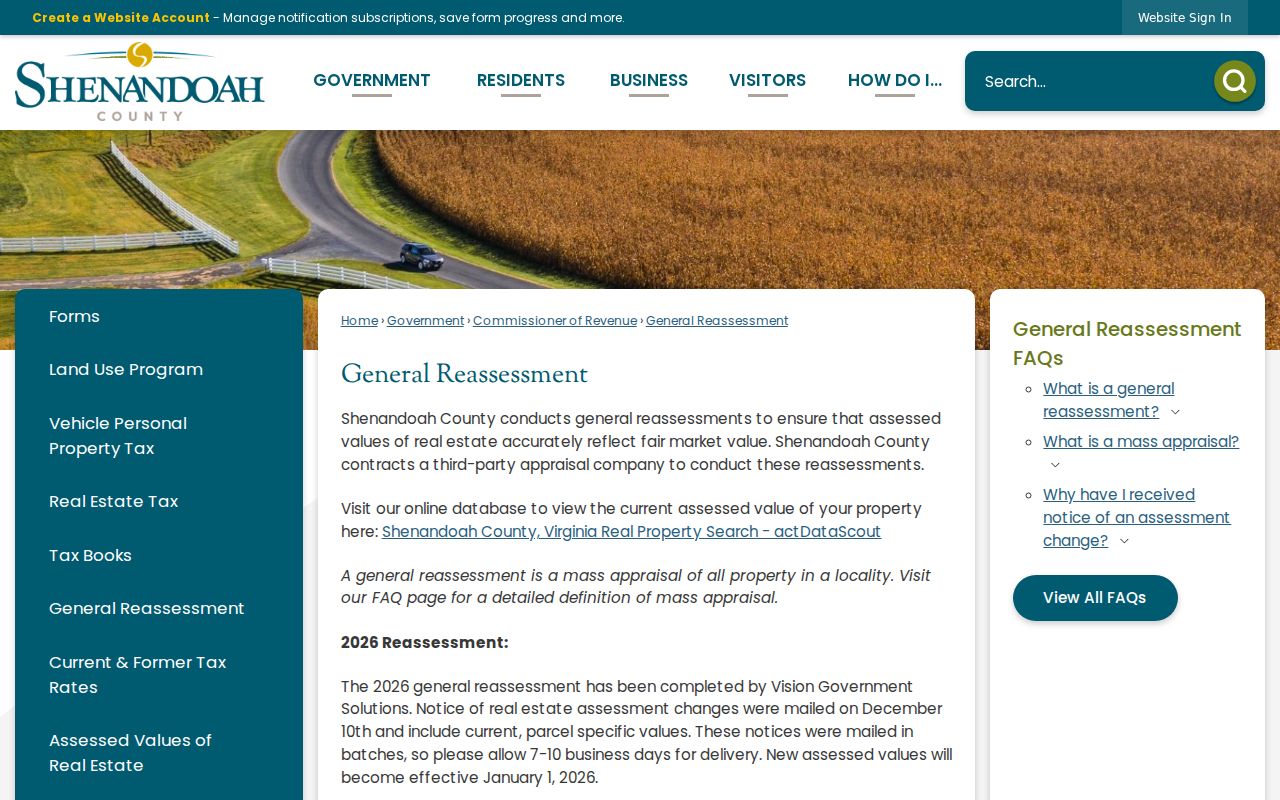
This image connects the 2026 value cycle to the official county source. It is not an appraisal of any named parcel.
Virginia Assessment and Ratio Context
Virginia's stated standard is 100% of fair market value. Assessments still drift from the market over time. A state sales-assessment ratio study compares assessed values with sale prices statistically. A county median ratio cannot tell one owner what a parcel would sell for. The 2024 study lists Shenandoah's latest reassessment as 2022. It reports a 74.00% median ratio for the county. Read the study as statewide oversight. It is not a private valuation or a market price for a single parcel. The new 2026 cycle shifts the time frame, so an earlier study should not be applied as a direct adjustment to a 2026 assessment. The Virginia 2024 assessment-sales ratio study gives the reported county measure and study context.
Land and Improvement in the 2026 Book
The assessment book splits land from improvements and sums them into a total. One 2026 entry shows the pattern. Madison Heights Subdivision, Section 10, Lot 166 lists 0.302 acres, land at $80,500, and an improvement at $468,900, for a total of $549,400. The tax field reads $2,637.12. Those are book figures for the assessment year. They are not a market offer or a recorded deed price. Other rows show vacant land with no improvement amount. The split shows how the county assigns value. It leaves out a full appraisal narrative, all property characteristics, and the deed book and page. Copy the account and description to find related assessor or land records; the 2026 Shenandoah County Real Estate Book is the source for the sample fields.
Assessment and Recorded Sale Price
The assessment book sample shows no last sale date. It also omits any deed reference or recorded price. Those facts live in the land record itself, appearing only when a deed or its image includes them. So the SRA result fields should not be read as a complete sale-history panel for Shenandoah County parcels.
A deed still proves what matters most. It documents a recorded transfer and its stated terms. That is different from a market appraisal. Relationships, conditions, and timing can all pull a price away from fair value. A recorded sale can still serve as a comparison when the parcel and date line up. For the record trail behind a sale, search the Virginia SRA/COVERS land-record index and confirm local access with the Circuit Court Clerk.
Values Change Through Manual Updates
County implementation material says deeds and wills are retrieved weekly. Staff then update ownership and parcel details by hand. The work draws on recorded instruments and plats. The county publishes no exact closing-to-roll lag. So no one can say how fast a fresh sale becomes a usable comparable, and a value record may simply sit at a different moment than a newly filed deed.
Keep three dates side by side. Pair the record date, the effective tax year, and the deed's recording date before comparing anything. A new assessment is not a sale event. An owner change alone triggers no reassessment. When an assessment detail looks wrong, confirm the parcel facts with the Commissioner of Revenue.
Notices for the current cycle began mailing December 10, ahead of the January 1, 2026 effective assessment date. The Board of Equalization route runs by appointment. The board may affirm, raise, or lower a value after weighing the evidence. A hearing is therefore more than a request to match a sale price or trim a bill, so keep factual corrections and comparables tied to the parcel and its valuation date.
Separate Value from Tax Bill
Shenandoah County taxes at a rate per $100 of assessed value. The 2026 book lists .4800 for the county. Billing adds another layer. Locality and district charges shape the final tax amount, while the assessed figure only describes the property's tax value. Check each figure for the matching year and district.
Town properties can carry a second bill. Stoney Creek and Toms Brook-Maurertown sanitary districts may add charges too. Exemptions change the bill, not the price. For payments, relief, and appeals, turn to Shenandoah County property tax records; a parcel lookup starts on the property search page.