
What the Shenandoah County Current Owner Record Shows
An owner-of-record check in Shenandoah County draws on more than one source. The 2026 real-estate book is the primary one. It verifies owner names, descriptions or locations, land, improvement, and total values. Tax and account fields appear alongside them. Some rows add a mailing address, acreage, half-year amounts, and district. What the book lacks is a deed reference. It also carries no complete sale history. The recorded instrument has to come from the Clerk.
| Owner name | The assessment book lists the owner; exact live card label is not confirmed. |
|---|---|
| Mailing address | Appears in some tax-book examples and may differ from property location. |
| Situs / description | Street location, subdivision, tract, acreage, or other legal wording. |
| Current assessed value | Land, improvement, and total fields; 2026 value is effective January 1, 2026. |
| Last transfer / deed reference | Check the Clerk's index; the 2026 book extract does not show the instrument. |
| Roll update timing | Deeds and wills are retrieved weekly; exact closing-to-roll lag is not published. |
The owner of record is the name tied to the parcel in a public record. It says nothing about who lives there. A situs address marks the property's location. A mailing address directs tax correspondence. Neither an address record nor a relief record proves present occupancy.
Confirming the Current Owner in Shenandoah County
Start with the assessment roll to find the parcel. Then verify the transfer with the latest recorded deed. When the records disagree, compare the legal description, parties, recording date, and instrument rather than picking one name without context. Shenandoah County updates ownership manually, so the Clerk's recent instrument can be newer than the tax-roll entry.
- Search the county-linked assessment portal by address, owner name, or parcel and copy the owner and location details.
- Search Virginia SRA/COVERS for the latest recorded conveyance that matches the same parcel and description.
- Compare grantor, grantee, instrument type, and recording date; ask the Clerk about an image if the index alone is unclear.
- If the grantee is an LLC, use Virginia SCC's entity search to verify the registered filing name and status.
- Owner of record
- The party named on the current assessor roll or most recent recorded transfer.
- Assessment roll
- The county list used to value property for local real-estate tax.
- Situs / mailing
- Property location and tax correspondence address, which may differ.
- Recording lag
- The interval before the assessment record reflects a deed already filed with the Clerk.
Contact Clues in the Shenandoah County Roll
A mailing address can help separate one owner record from another person with the same name. It is not proof of residence. The Shenandoah County assessment book places the owner, mailing address, property description, account, land, improvement, and total value in a single row. The roll exists for assessment and tax work. Take any property matter through official channels. Avoid republishing personal details that are not needed.
Lawful use. Public owner information supports legitimate property research and due diligence. Do not use it to stalk, threaten, or harass anyone.
January 1 and the Current Assessment
Shenandoah County's 2026 general reassessment takes effect January 1, 2026. Virginia requires assessment at 100% of fair market value. That date marks the effective valuation period. It does not guarantee that every deed recorded near that day is already reflected in an online owner field. Vision Government Solutions completed the reassessment work. County notices went out in batches beginning December 10.
For any specific parcel, check the live assessment system. A current assessment and a current owner transfer are related but separate questions.
The county reassessment notice explains the effective date and the local review route.
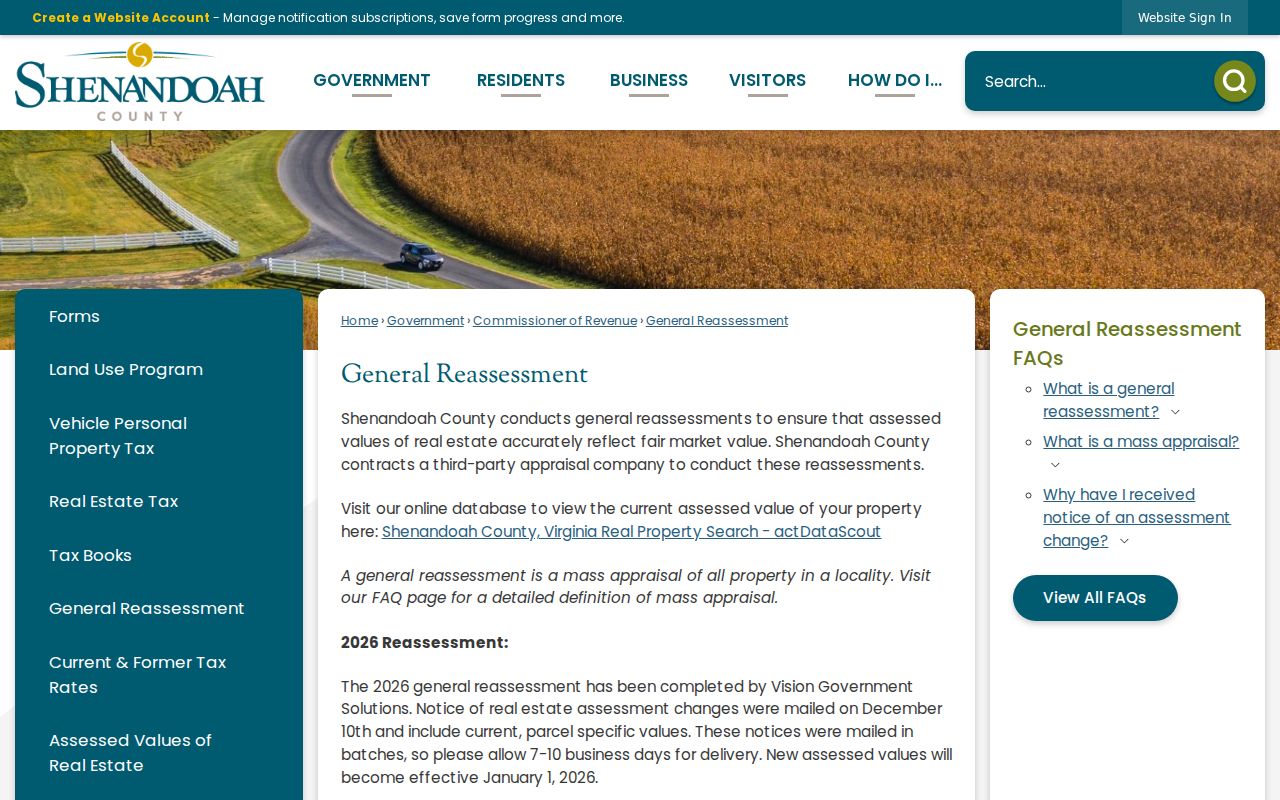
This capture points to the 2026 assessment information, not a parcel-specific ownership result.
Weekly Retrieval Does Not Set a Lag
County implementation material describes a weekly routine. The Commissioner pulls deeds and wills from the Clerk weekly. Ownership, mailing address, and parcel details are updated by hand. The updates draw from deeds, surveys, and plats. New, consolidated, and subdivided parcels get valued individually by the Real Estate Clerk. None of this sets a firm lag. The county publishes no usual number of days from closing to update.
Compare the roll with the latest recorded deed. Note both dates. A deed naming a new grantee while the roll still shows the seller means something. The two systems sit at different points in the manual update. Ask the Commissioner about the roll and the Clerk about the instrument.
LLCs, Trusts, and Fiduciaries
Sometimes the owner shown is an entity or fiduciary. A result does not always name a natural person. The Virginia SCC Clerk's Information System searches an entity by name or ID and displays status, address, formation date, and filings. Those details identify the registered organization, but they do not make the agent or officer the owner of the land.
When an estate appears, the Circuit Clerk also holds wills and fiduciary qualification files. Compare the deed, order, or fiduciary instrument with the assessor's parcel. The public assessment name is the record owner. It does not explain beneficial ownership. Nor does it settle authority to act. Use the Virginia SCC business search for entity names connected to a recorded owner.
Checking an Owner Through the Clerk
The Circuit Court Clerk keeps Shenandoah County's permanent land records. The office at 112 South Main Street in Woodstock is open weekdays from 9 a.m. to 5 p.m. The public index may run through Virginia SRA. Images are not automatically free. Some require a clerk-authorized subscription. Ask the office about current image access, copy charges, or a certified copy. Copy prices come from the office itself. For an owner check, preserve the instrument reference, grantee spelling, legal description, and recording date. For a full chain review, use the dedicated Shenandoah County deed-records process, or for a broader address-to-owner route, the owner lookup method. The Clerk's official page shows the access route.
Shenandoah County Owner Relief Limits
Shenandoah County's elderly and disabled tax relief program turns on title held on January 1. It also turns on income and net-worth tests. And it requires an application filed each year by March 1. A relief flag can explain an exemption on a tax account. It cannot tell you who occupies the property. Nor can it tell you whether a fresh deed has reached the online roll. The exemption schedule and eligibility amounts live on the current county application. Confirm those figures with the Commissioner of the Revenue. Never read a tax-relief flag as proof of where a person lives. Ownership still rests on the parcel record and the latest recorded deed.
After a recent purchase, track three dates on paper. Note the transfer or closing date. Note the recording date on the instrument. Note the date you checked the assessor roll. Each date answers a different question. The deed reflects the land record as recorded. The tax roll, by contrast, is a manually maintained assessment and billing reference. A weekly deed retrieval process gives no promise that both screens update at once.
Compare more than a mailing address. Match the grantee's full legal name against the complete property description. A trust, estate, or LLC may hold title. And one parcel can carry more than one vesting party. When the roll looks stale, ask the Commissioner for an update. When the deed itself reads unclearly, request the filed instrument from the Circuit Clerk. Seek professional title review before any transaction.
Shenandoah County's 2026 reassessment took effect January 1, 2026, with notices mailed beginning December 10. That effective date governs the assessment cycle alone. It is not a deed's recording date. It is not live proof of occupancy either. If a notice and the latest instrument show different names because of timing, compare the parcel description. Then ask the Commissioner which roll entry is active for tax administration.