
Searching Shenandoah County Property Records
Start with the question you actually have. An address or an owner name will locate a parcel in the county-linked property and GIS system. The tax map reference that comes back can then link the assessment roll, the Treasurer's ticket, and the recorded deed. Remember what each piece is. A GIS outline is a locator, not a legal boundary. An assessor's owner field may not show a brand-new transfer. When a sale has just closed, the Clerk's latest recorded conveyance is the better check.
Use the sources in sequence and keep their roles straight. The county says ownership details are updated manually, after deeds and plats are retrieved weekly. But it publishes no usual closing-to-roll lag. If an online record is missing or the image is restricted, the courthouse counter, a written request to the custodian, the Library of Virginia catalog, or a local archive may be the next stop.
- Search the county-linked assessor or GIS by address, owner name, or the tax map key. Check that the map point matches the property you mean.
- Copy the parcel number and legal description, then use the Virginia land-record index to find the latest deed by party name.
- Use the Treasurer's e-Treasurer inquiry to review a tax account and its payment history.
- Read the GIS layers for zoning, aerial, district, topography, and floodplain clues, then turn to a recorded plat or survey for boundary questions.
- Ask the custodian about image access, older volumes, or certified copies when the public index does not answer the question.
For an address or owner clue, the county-linked actDataScout property search is where a Shenandoah County property search begins.
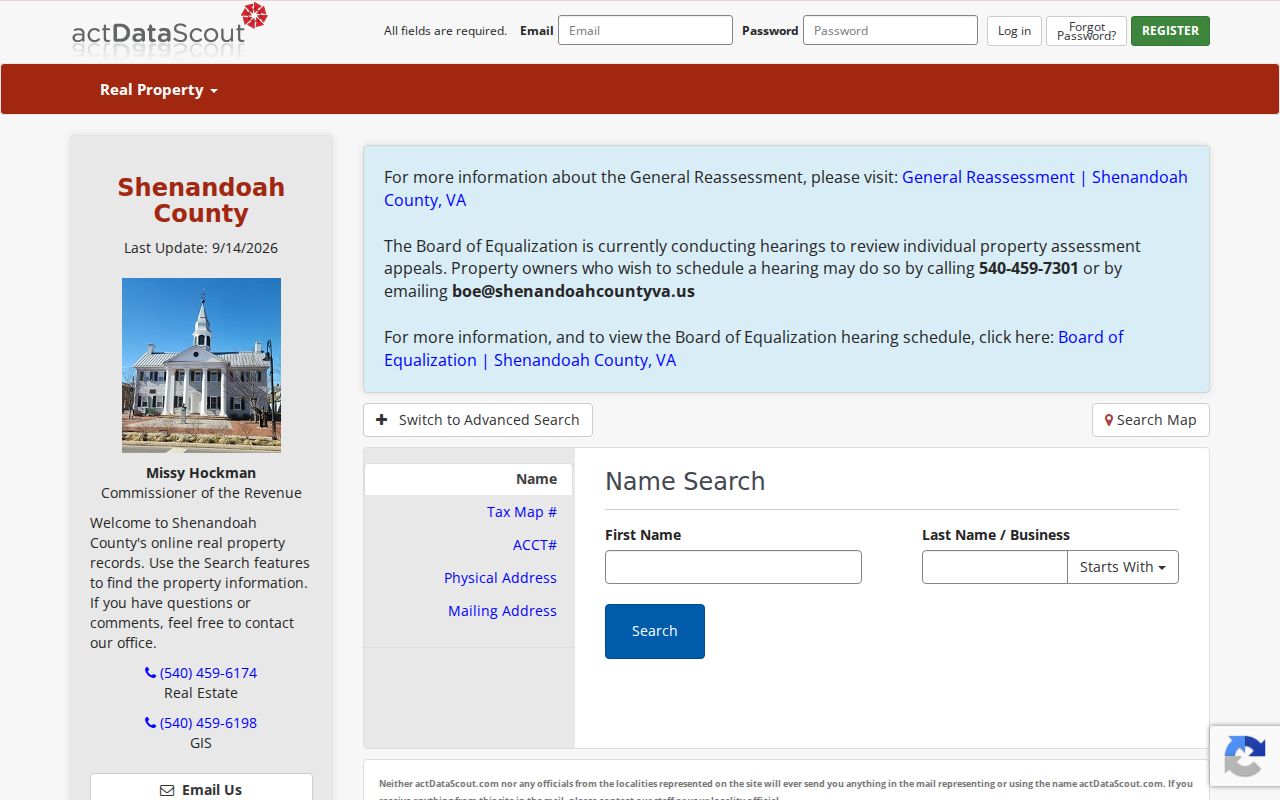
The actDataScout entry screen routes a search through the assessor and GIS side of the county's property records. Fields and record coverage in the live portal should still be confirmed there before relying on any single result.
Offices Keeping Shenandoah County Records
Woodstock, the county seat, is the practical center for Shenandoah County's property-record desks. The Circuit Court Clerk preserves deeds and the other permanent land instruments. The Commissioner of Revenue maintains assessment and parcel ownership details. The Treasurer handles tax tickets and payments. Community Development and the individual towns keep zoning and permit material. For older records that a current web portal does not reach easily, the Library of Virginia and the Shenandoah County Library help bridge the gap.
Shenandoah County Circuit Clerk
112 South Main Street, Woodstock, VA 22664
540-459-6150, weekdays 9 a.m. to 5 p.m.
Commissioner of Revenue
600 North Main Street, Suite 102, Woodstock, VA 22664
540-459-6165, weekdays 8:30 a.m. to 5 p.m.
Shenandoah County Treasurer
e-Treasurer public inquiry and tax payment history
540-459-6180
Shenandoah County Property Record Types
Shenandoah County property records are split by function, not gathered into one file. A deed records a transfer or another land instrument. The assessment roll assigns taxable value and ties an owner name to a parcel. The Treasurer's records show payments and account history. The GIS map supplies the spatial view. Permit forms add their own picture of approved work and land-use review.
| Record Type | What It Documents | Kept By | Access |
|---|---|---|---|
| Deeds and land instruments | Transfers, liens, easements, releases, plats | Circuit Court Clerk | SRA index; images by clerk-authorized access; counter |
| Assessment roll | Owner, parcel, land, improvement, and total value | Commissioner of Revenue | County-linked actDataScout portal |
| Tax tickets | Account, payment history, and yearly taxes paid | Treasurer | e-Treasurer name, account, or parcel inquiry |
| Parcels and plats | Map location, zoning layers, lot depiction | County GIS and Circuit Clerk | GIS viewer; recorded plat and survey records |
| Permits and plans | Project, jobsite, use, plans, and approvals | Community Development or town | Application packets and office requests |
For a recorded transfer or a full chain of title, use the Shenandoah County deed records. For a tax ticket or assessment question, start with the relevant county tax office. Keep the valuation record separate from the payment record.
Limits of Shenandoah County Property Records
Public land records show what was filed and indexed. They do not guarantee that every interest has been found. An assessment is a tax valuation, not a private appraisal. A GIS parcel line is not a surveyed boundary. The current tax-roll owner can lag behind a deed that was just recorded. For title certainty, boundary disputes, or a legal interpretation of any property record, use the proper professional. Also consult the custodian's original document.
Lawful use. Shenandoah County records support property research, purchase diligence, and civic review. Do not use an owner's information to stalk, threaten, or harass anyone.
Virginia SRA Deed Index Access
The Clerk's permanent land records cover deeds, deeds of trust, mortgages, releases, assignments, powers of attorney, and plats. Related instruments are kept there too. Virginia Secure Remote Access, called SRA or COVERS, provides land-record access. A local clerk must enable it. The statewide service offers free index-only access. Document images are a separate matter. They may require a clerk-approved subscription and a signed agreement. Shenandoah County publishes no firm start year or current image fee for its online deed records. Ask the Clerk before assuming a date range or an available image.
When a web index gives a party name and a recording reference but no readable image, note the names, the instrument type, and the date. Contact the Clerk with those details. Courthouse staff can guide access to public files under staff direction. A written request under the Virginia Freedom of Information Act should name the parcel or parties, the record type, and the approximate date range. Include the preferred format as well. Confirm copy charges and certified-copy prices with the office directly. Open Virginia's SRA land-record portal for the index route. The county Clerk's page lists the local custodian and the access details.
Shenandoah County's 2026 Values
Virginia requires local real estate to be assessed at 100% of fair market value. Shenandoah County's prior general reassessment took effect January 1, 2022. Vision Government Solutions completed the next reassessment for an effective date of January 1, 2026. A reassessment changes the tax roll value only. It does not touch the deed or the parcel boundary. When a new figure arrives, compare the notice, the parcel facts, and the current assessment detail. Do not treat a rise by itself as proof of error.
The county says notices were mailed in batches beginning December 10. The Board of Equalization hears appeals by appointment. Evidence may include a factual correction or comparable sales. A current listing, a licensed appraisal, or proof that similar properties are treated differently can also support an appeal. The board may affirm, raise, or lower the assessment. The county reassessment page gives the current process and its evidence guidance.
Shenandoah County Tax Ticket Search
The Treasurer's real-estate inquiry offers three search keys: name, account number, or parcel number. The name screen takes a last and first name. It returns a list of matching accounts. Pick one and you get payment history, which leads to the detail view. The account and parcel modes take their own number plus an optional projected date. That date lets you figure penalty and interest through a chosen day. Skip it and the system uses the current date.
The landing page also accepts Department and Ticket Number for real-estate payment. Payment history and yearly real-estate taxes paid sit apart from the assessor's valuation record. Delinquent land unpaid for three years or more may carry added costs. The public inquiry instructions describe the buttons and screens. But they leave out some ticket fields, like the full levy and receipt detail. Check the ticket itself, or call the Treasurer at 540-459-6180 if a field is unclear.
The e-Treasurer landing page links payment and inquiry options.
Layers in the Shenandoah County GIS
Shenandoah County's newer interactive GIS connects to actDataScout. It finds a parcel by address or owner. It layers on real-estate data, zoning, aerial photography, district information, topography, and floodplain detail. For zoning, the county gives a direct sequence. Find the address or owner, choose Identify, and click the parcel. Wait for the pop-up, open the layer menu, and select Zoning. The pop-up can then show a description and the locality's zoning designation.
The GIS department page cautions that parcel information may be inaccurate while data is being transformed. It also notes the map is not a legal description. Parcels with unknown boundaries carry an octagonal symbol. That mark tells you to stop trusting the drawn edge. Check the recorded plat or order a survey. GIS works well for orientation and record cross-reference, not for setting a fence. See the county GIS page and its open-data notes at shenandoahcountyva.gov/Geographic-Information-Systems-GIS.
Town Bills Across Shenandoah County
Strasburg, Woodstock, New Market, Mount Jackson, Edinburg, and Toms Brook are incorporated towns inside Shenandoah County. They are not independent cities. The county still holds the principal deed, assessment, and GIS records. Building-code records for town property stay with the county. A town can set its own zoning and issue a separate real-estate bill. Sanitary district charges may add another account for property in Stoney Creek or Toms Brook-Maurertown.
Always read the district or locality label on a tax record before comparing amounts. The 2026 real-estate book lists town and district labels alongside accounts. It is an assessment book only. It is not proof of a sale price or a complete current bill. Woodstock and Strasburg examples show the range. Mailing address, property location, acreage, land value, improvement value, total value, tax, and account number can sit together in one county record. That mix makes the county book a useful cross-check across town lines.
Permits in Shenandoah County Towns
Planning authority and building-code administration do not always share one office. Strasburg governs zoning within its limits. It reviews site plans, subdivision plans, plats, special-use permits, rezonings, and comprehensive-plan changes. Stormwater and BMP review goes to Shenandoah County instead. The county Building Official enforces state building-code compliance. The county's Community Development office sits at 600 North Main Street, Suite 107, Woodstock. It handles permit packets for both county and town properties.
A county zoning permit is required for an improvement even when no building permit applies. The residential packet records the owner, mailing address, jobsite, and whether the location sits in a town or county area. It also records proposed use, structure, project cost, plans, and agency approvals. The county reports permit fraud. A license holder must pull the permit or file an authorization affidavit. Note that the application index is not an address-keyed public search database. The county permit page supplies the packet and current office routing.
Shenandoah County Deed Books Before Online Search
The historic land-record path here runs unusually deep. Library of Virginia catalog listings show Shenandoah general deed indexes spanning 1772 through 1921. Deed books begin in 1824. Release deed books run from 1883 to 1919, and surveyor books appear as early as 1785. County Court Papers start in 1787. Land grants date from the 1790s. The online SRA start year for this county remains unconfirmed. Treat a modern portal as no substitute for those older indexes.
Work from a party name or tract clue in a general index first. Note the deed book and page, then track down the original image or microfilm. The Clerk maintains that permanent county records are continually microfilmed. They are securely stored at the State Library in Richmond. Shenandoah County Library's Shenandoah Room and Truban Archives add local photographs, ledgers, business files, and letters. FamilySearch offers an abstracted first volume of deed books. That is handy for locating a reference but worth checking against the original. View the Library of Virginia's Shenandoah catalog before planning a trip or interlibrary request.
Shenandoah County Tax Sale Records
Shenandoah County tax sales usually land in spring and again in fall. The county posts each new date once it is set. Auctions take place in the Board of Supervisors Meeting Room. That room sits at the Government Center, 600 North Main Street in Woodstock. Anyone wanting the sale list can ask the county's special counsel. Leave a mailing or email address. The list goes out roughly three weeks ahead of the auction.
Payment at a Shenandoah County tax sale can run through cash, card, personal check, cashier's check, or money order. Proceeds first cover the delinquent taxes. The purchaser still owes any balance, recording fees, costs, and buyer premium. A former owner may petition within 90 days after the decree is confirmed. That right applies only in narrow circumstances. The court keeps final say over the sale. Read the full terms before bidding. Bring title questions to a lawyer.
The county Land Sales page posts the venue. It also gives the sale-list request route, accepted payment forms, and the purchaser rules.
Addressing Shenandoah County Parcels
Three addresses attach to any Shenandoah County parcel. The situs address marks where the land or structure sits. The mailing address tells the assessor where notices go. The deed's legal description fixes the boundaries in recorded terms. These entries can disagree.
County GIS handles E911 addressing but will not address vacant land. A new address for an occupied structure follows GPS mapping. That mapping covers the driveway or access and the foundation. Inside town limits, a town may assign the address. County GIS still maps it for emergency response. USPS, not the county, controls ZIP codes and place names. Woodstock shows 22664 on county records. Strasburg shows 22657 on town material, yet the county publishes no complete ZIP roster. A postal label alone cannot settle which town's zoning applies. Check the mapped parcel against the town boundary first, then take any disputed postal label to USPS.
Shenandoah County's Record Trail
Shenandoah County records now live partly online and partly in older clerk and archive material. The assessor GIS and the Treasurer inquiry are county-linked services. SRA provides index access where enabled, though images may require a subscription. Older books and plats can call for more effort. Counter help, microfilm, an archive catalog, or a direct request may be needed. Virginia FOIA presumes records are open unless an exemption applies. A written request draws a response within five working days. Clarification or a permitted extension can stretch that clock.
You can rebuild a parcel history step by step. Combine today's tax-map description with the recorded deed index, a plat, older general indexes, and surveyor books. Names and tracts shift as streets and subdivisions grow. An address alone is a weak key for older farms. Keep each record's date and reference as you work backward. That paper trail beats treating one portal result as the whole story.