
Finding Who Owns a Shenandoah County Property
Work from the parcel outward. A broad name search rarely settles anything. An address run through the Shenandoah County assessor GIS locates the likely parcel, and the roll then supplies the owner name along with a mailing clue. The newest recorded deed confirms the transfer. When an entity holds title, the state business index shows the filed entity name. Together these steps identify the owner the property records name, not who is standing on the land.
- Locate the parcel from the address or owner name in Shenandoah County's linked assessor and GIS search.
- Write down the owner name, description, and parcel reference. Keep mailing address separate from the property's situs.
- Search the Clerk's SRA/COVERS index for the latest deed that matches the grantee and legal description.
- If a corporation or LLC holds title, check its filed name in Virginia SCC's entity search; do not assume the registered agent owns the land.
Where Shenandoah County Names an Owner
Different county records answer different questions. The assessor's tax roll ties an owner to a parcel number. The Clerk's deed index names the parties to each recorded instrument. A GIS map places the parcel but proves no title. Virginia SCC records may explain an entity's filed name and status, while the Treasurer's tax bill shows account activity rather than ownership.
| Source | Owner Info It Gives | Access |
|---|---|---|
| Commissioner of Revenue roll | Owner name and assessment parcel association; some book entries show mailing and location details. | County-linked property search and published tax book. |
| Circuit Court Clerk deed index | Grantor, grantee, instrument, and recorded transfer reference. | Virginia SRA index; image access may need Clerk authorization. |
| County GIS | Parcel location, tax map reference, zoning, and map layers. | Interactive viewer; informational only. |
| Virginia SCC CIS | Entity name, status, address, formation date, and filings. | Public entity-name or ID search. |
An owner of record is the party the Shenandoah County assessment system or a recorded deed names. A grantee receives the interest a deed conveys. That is legal ownership only. Who is present at the property is a different question, and public records should not be used to infer occupancy or target a person.
- Owner of record
- The name carried in the assessor's public roll or a recorded instrument.
- Grantee
- The person or entity receiving an interest in a deed.
- Title
- The legal rights shown through a full chain and review, not one search result.
- Situs address
- The property location; a mailing address is where a tax notice is sent.
Limits of a Shenandoah County Owner Search
A roll name never shows occupancy. It also cannot reveal who may act for an LLC or a trust. The Shenandoah County deed index is not a title opinion, and a fresh transfer may reach the tax roll only after the instrument is recorded. Some addresses carry protection through Virginia's Address Confidentiality Program run by the Attorney General. That shield matters. Keep any property search to lawful property, civic, or purchase questions.
Lawful use. Shenandoah County owner information is for lawful property research and due diligence. Do not use it to stalk, threaten, or harass any person.
Owner Name on the Assessment Roll
The Commissioner of the Revenue keeps the assessment roll. County GIS instructions also document an owner-name search. Either route leads to a live parcel card naming the owner. The county's 2026 real-estate book shows the same fields. Owner names sit alongside the mailing address. In its examples the book lists the description and location, account, land and improvement values, total, tax, and district for each parcel.
Cross-check the parcel in the Clerk's deed records before calling the name settled. Open the county-linked assessor search for the public roll.
The Commissioner of the Revenue sits at 600 North Main Street, Suite 102, in Woodstock, reachable at 540-459-6165. Published hours run 8:30 a.m. to 5 p.m. Ask about an assessment name, a mailing address, a parcel description, or a roll correction. The assessor does not hold the deeds. The Circuit Court Clerk records the instrument behind a transfer. That office confirms the filed deed, not the tax roll value.
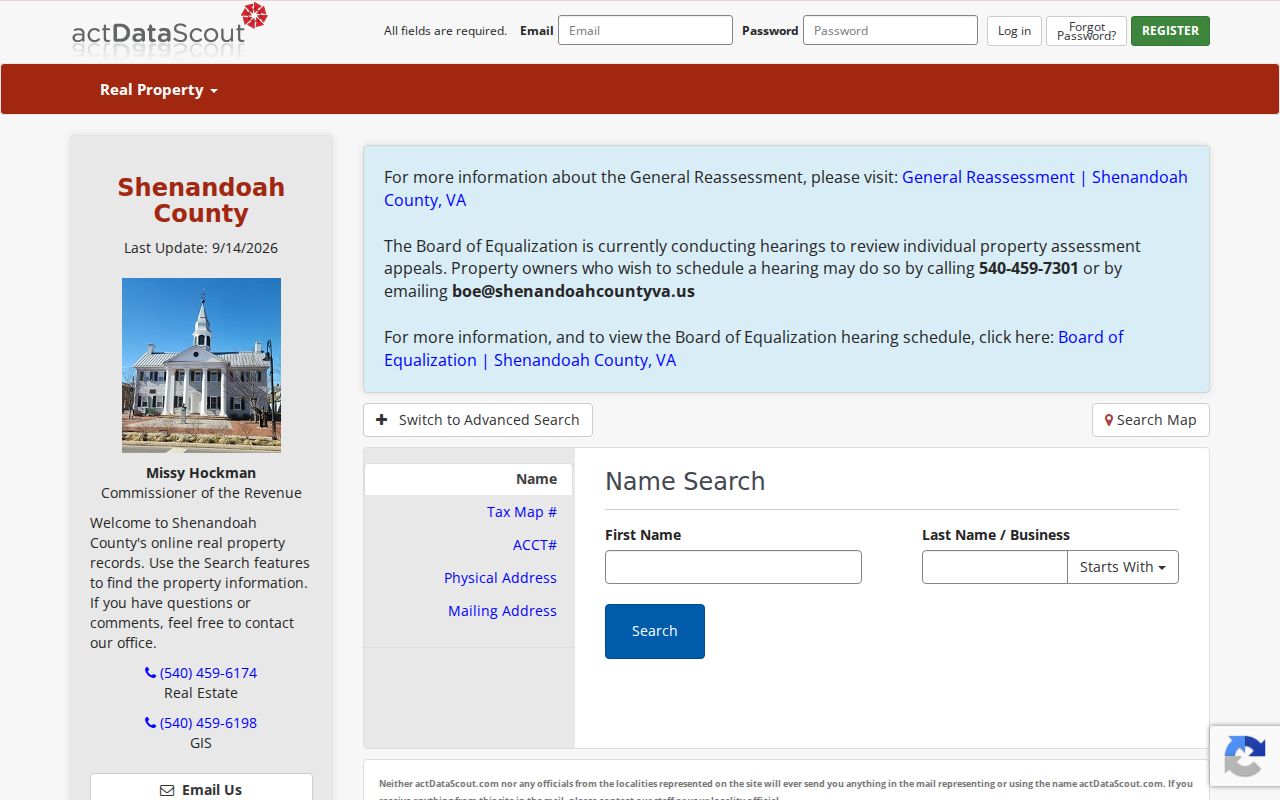
Take the parcel number next. Confirm the same parcel in the Clerk's deed records before treating the assessor name as settled ownership of the Shenandoah County property.
Mailing Address and Property Situs
A tax bill can travel anywhere. The mailing address often differs from the situs. The Shenandoah County 2026 book shows the two side by side, with examples of a post-office box listed apart from the street location of the property. A mailing address can separate two similar owner records. It proves no residence, occupancy, or preferred contact method beyond the ordinary property process.
An address search sometimes returns several parcels. Compare the location description and tax map reference instead of taking the first owner-name match. Rural tracts complicate things. A legal description may rest on acreage, subdivision wording, tract language, or a nearby road rather than a modern street address.
Weekly Deed Retrieval and Roll Lag
Roll updates take time. County implementation material describes the workflow. Deeds and wills are retrieved from the Circuit Clerk weekly, and staff manually update ownership, address, and parcel details from deeds, surveys, and plats. That describes the county's process. No typical gap between closing and a roll refresh is stated.
A recorded deed can beat the roll. When the assessor name has not changed after a new deed is recorded, treat the deed as the current transfer reference. Ask the Commissioner when the tax roll will refresh. Do not read the older roll value as proof the deed failed. A title company or attorney can weigh the full legal effect when a transaction depends on it.
LLC, Trust, and Estate Names
Not every owner of record is a person. An LLC can hold the parcel. Virginia's State Corporation Commission runs a Clerk's Information System for searching business entities by name or ID. The listing shows status, address, formation date, and filing history. It confirms a company name is real. It also points to the registered office. Remember, though, that the agent or officer named is not automatically the individual owner of the parcel.
Estates work differently. The Circuit Clerk holds wills and fiduciary qualification files. A transfer may appear as an executor or fiduciary deed, a court order, or another recorded instrument. A will can name heirs, but the recorded deed or order is the property-transfer reference to weigh against the tax roll. The Virginia SCC entity search is the official lookup for a registered business name.
Privacy Rules for Owner Information
Virginia's public-record law does not open every personal field. Voter registration records stay closed under Va. Code §24.2-404(B). Vital certificates open on different clocks. Births wait 100 years and deaths 25 under §32.1-271. The Attorney General's Address Confidentiality Program gives qualifying participants a substitute address. Protected voters or officials may have addresses withheld under applicable rules.
These limits matter when two names or addresses seem to conflict. A protected mailing address will not match the physical parcel. A restricted voter or vital record is not the missing link in a property search. Public assessment fields exist for tax administration. They do not reveal every personal circumstance behind a name. Stick to the public deed, assessment, and parcel information needed to identify the property. Leave unrelated sensitive records out of the search.
Such protections never turn the deed record into a private contact database. Use official processes for corrections or safety concerns. Do not republish sensitive details. If a protected address or sealed record shows up elsewhere, contact the source custodian. Do not repeat it.
Business and estate names raise separate questions. The SCC entity record confirms a registered organization and its public status. It does not show who benefits from the company or who can sign for a particular parcel. The SCC record stops short of ownership. A probate file may explain an executor's role in a deed. Even so, the latest recorded instrument remains the transfer source. Keep those questions separate when reporting who owns the property.
A wrong assessment entry needs a precise fix. Contact the custodian with the exact parcel and the field needing review. A Virginia FOIA request for an existing public record generally draws a response within five working days. An office may seek clarification. It may use a permitted extension. It may also charge reasonable search and copy costs. That process can locate a document. It does not certify that a person holds clear title.
The Virginia Address Confidentiality Program page is the official source for program eligibility and enrollment.